Language Model Teams as Distributed Systems
Language Model Teams as Distributed Systems
Everyone is building multi-agent AI systems.
Very few can explain when they should work.
That’s the gap this paper fills — and it does it in a way that fundamentally reframes how we should think about agents.
For the past 2 years, agent design has mostly evolved through patterns:
- Planner → Executor → Reviewer
- Parallel agents
- Debate systems
- Hierarchical teams
They tell you how to build, not when it will work. This paper introduces something much more powerful:
A theoretical framework to predict when LLM teams help, when they hurt, and why.
The core idea (and why it matters)
LLM teams are not just collections of agents. They are distributed systems.
Each agent:
- operates with local context
- communicates via messages
- runs concurrently
- can fail or hallucinate
This is structurally identical to distributed computing.
And that means:
Decades of distributed systems theory now apply to agent systems.
What the paper actually proves (not just claims)
The authors test this idea with controlled experiments:
- teams of 1–5 agents
- real coding tasks
- varying dependency structures (parallel → serial)
This lets them evaluate both:
- scaling behavior
- coordination effects
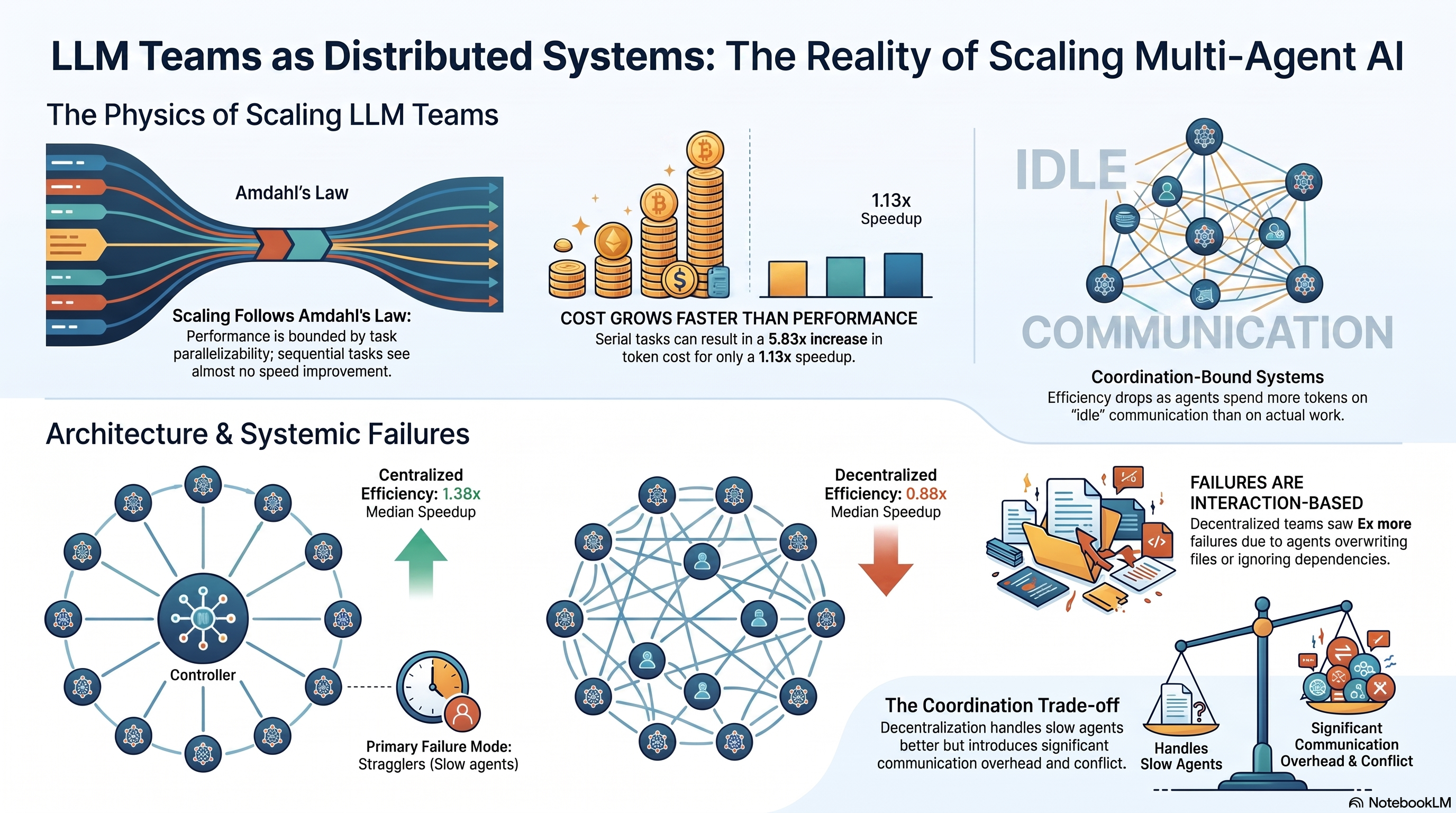
1. Scaling is not free — it follows Amdahl’s Law
The results show:
- Highly parallel tasks → strong speedups
- Mixed tasks → diminishing returns
- Sequential tasks → almost no improvement
This directly validates a core distributed systems law:
Performance is bounded by task parallelizability.
Not by how many agents you add.
2. Coordination overhead is the hidden limiter
Even in parallel tasks:
Teams underperform theoretical limits.
Why?
Because agents must:
- communicate
- synchronize
- coordinate work
And that introduces real overhead.
This is why:
more agents ≠ proportional speedup
3. Architecture changes everything
The paper compares two setups:
- centralized (pre-assigned tasks)
- decentralized (agents self-coordinate)
Result:
Decentralized teams were significantly less efficient.
Median speedup:
- centralized ≈ 1.36× • decentralized ≈ 0.88×
This is a critical insight.
Autonomous coordination sounds powerful - but often introduces more problems than it solves.
4. Failures are systemic, not random
In decentralized teams, the authors observe:
- agents writing to the same file simultaneously
- agents overwriting previous work
- agents executing tasks before dependencies exist
These lead to:
~5× more test failures
This isn’t an “LLM limitation.”
It’s a consistency problem — a classic distributed systems issue.
5. Communication overhead grows with team size
As teams scale:
- message volume increases
- idle coordination rounds increase
- efficiency drops
Agents even produce messages like:
“I’m waiting for tasks.”
“Great job Dev1.”
Burning tokens. No progress.
This is a textbook case of systems becoming:
coordination-bound instead of compute-bound
6. Centralization vs decentralization is a real tradeoff
Centralized teams:
✔ fewer conflicts ✔ lower overhead ✖ vulnerable to slow agents (stragglers)
Decentralized teams:
✔ flexible task reassignment ✔ better handling of slow agents ✖ more conflicts, communication, inefficiency
This mirrors classic distributed systems tradeoffs.
7. Cost grows faster than performance
One of the most important findings:
Token usage often outpaces speedup.
Example:
- serial tasks → ~1.13× speedup
- token cost → ~5.83×
This means:
Multi-agent systems can be economically inefficient.
The real contribution of the paper
It doesn’t just suggest better patterns. It gives a way to answer a more important question:
Should you use a team at all?
Key takeaways
1. Task structure determines success
Parallelizable tasks benefit. Sequential ones don’t.
2. Coordination is the bottleneck
Not reasoning. Not prompts.
3. Architecture is a first-order decision
Centralized vs decentralized changes outcomes significantly.
4. Failures emerge from interaction
Not just individual agent mistakes.
5. Cost must be part of evaluation
Performance alone is misleading.
The shift this paper forces
From:
“how do we design agent behaviors?”
To:
“how do we design systems that coordinate intelligence efficiently?”
Because once you move from one model to many…
You’re no longer scaling intelligence.
You’re scaling coordination.
And that’s a much harder problem.