LiteLLM Attack
What if attackers could distribute malware through an official software release process - without modifying your source code or forging the software signature? That’s what happened in the LiteLLM supply-chain attack.
LiteLLM is a popular AI gateway that provides unified access to LLM providers such as OpenAI, Anthropic, Azure OpenAI, and AWS Bedrock.
The attackers compromised its release process and distributed a malicious version, through legitimate package registries.
How the Attack Worked
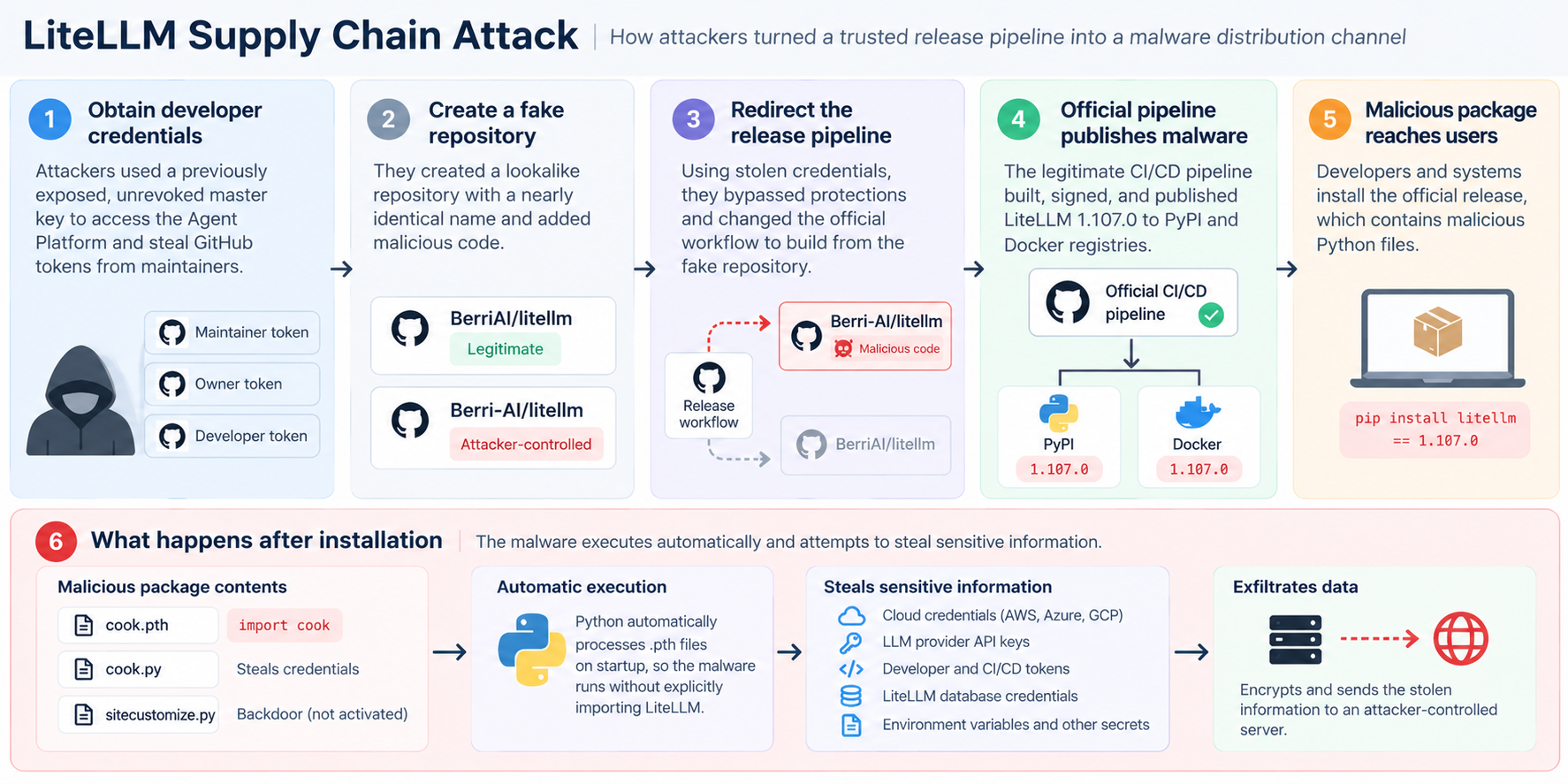
1. Credential compromise: Attackers exploited a previously exposed, unrevoked master key to obtain privileged GitHub OAuth tokens belonging to LiteLLM maintainers.
2. Fake repository: They created a lookalike repository, Berri-AI/litellm, resembling the legitimate BerriAI/litellm.
3. Pipeline hijack: Using stolen credentials, they bypassed repository protections and redirected the official release workflow to the malicious repository.
4. Legitimate distribution: LiteLLM’s actual CI/CD pipeline built, signed, and published the compromised release to PyPI and Docker registries.
5. Credential theft: Once installed, the malware could execute automatically when Python started, attempting to steal cloud credentials, LLM API keys, developer tokens etc.
The official source repository remained clean, while the officially published software contained malware.
The incident challenges 5 assumptions - 1. Source code review protects us. The official GitHub source was clean. Malicious code entered through a redirected build pipeline.
2. Signed releases are trustworthy. The compromised software was built and signed by the legitimate release pipeline.
3. Our CI/CD pipeline is trusted. Attackers manipulated the pipeline into building code from their fake repository.
4. No malicious installation script means we’re safe. A Python .pth file triggered malware execution during Python startup, without explicitly importing LiteLLM.
5. A compromised dependency has limited impact. The malware targeted cloud credentials, LLM provider API keys, CI/CD secrets, and developer credentials across the environment.
The fundamental problem was not simply malicious code. It was the compromise of the mechanisms organizations rely on to establish software trust.
The Clever Python Execution Technique The malicious package included a file called cook.pth. Python automatically processes certain .pth files when initializing its environment. This meant that starting a Python application, running a notebook, or invoking pip in an infected environment could execute the credential-stealing code to an attacker-controlled server.
What Should Software Architects and Security Teams Learn?
Five important takeaways emerge:
-
Verify build provenance, not just signatures. Establish that an artifact was built from the intended repository, commit, and approved workflow.
-
Treat CI/CD as critical production infrastructure. Protect workflow definitions, enforce independent approvals, and restrict privileged access.
-
Revoke exposed secrets immediately. Removing a leaked credential from GitHub does not make it invalid. Prefer short-lived credentials and least-privilege access.
-
Extend security monitoring to runtime behavior. Dependency scanning alone cannot detect every compromised build or malicious Python startup hook.
-
Isolate AI gateway credentials. Avoid giving a single gateway unnecessarily broad access to multiple cloud environments and AI providers.
Attackers no longer need to compromise the application source code itself.
Compromising the identities and automation that produce trusted software can be just as effective - and potentially harder to detect.
The question organizations need to ask is no longer just: “Can we trust this software?”
It is also: “Can we independently verify the process that produced it?”
#SoftwareSupplyChain #CyberSecurity #DevSecOps #AISecurity
Ref: LiteLLM 1.107.0 Supply Chain Attack: How a Hijacked Release Pipeline Signed Malicious Code